Introduction
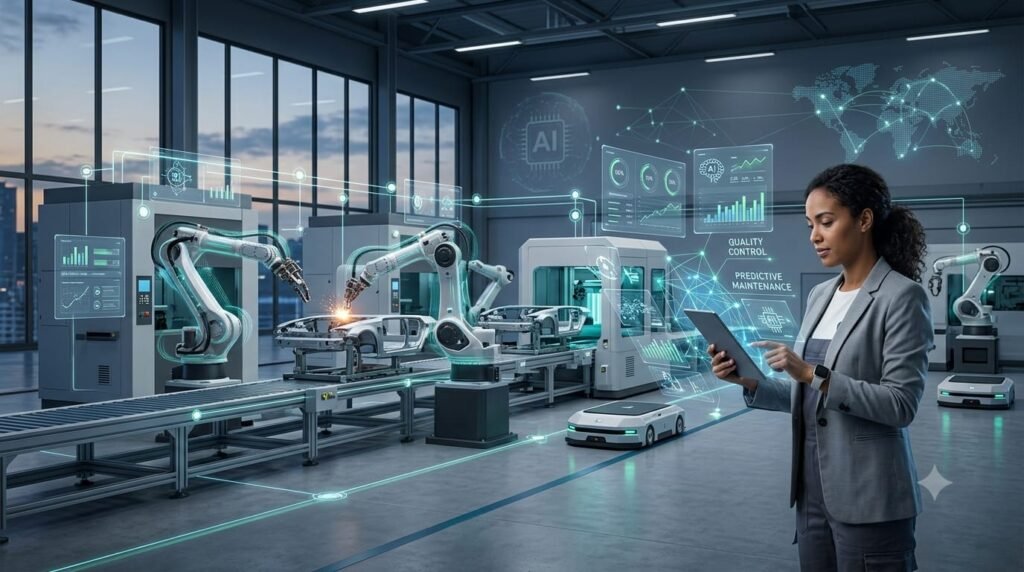
Manufacturing has always depended on machines, people and carefully planned processes. But as factories become more connected and generate larger amounts of data, traditional methods are no longer the only way to improve production. Artificial intelligence is giving manufacturers new ways to understand their operations and respond to problems before they become costly.
AI in manufacturing refers to the use of artificial intelligence to improve processes such as production planning, quality inspection, machine maintenance, supply-chain management and automation. Instead of simply collecting information from machines, AI can analyze that information and help manufacturers identify patterns, predict possible problems and make better operational decisions.
This guide explore how AI is being used across manufacturing, the technologies and platforms supporting these changes, the benefits and challenges involved and what the future of intelligent manufacturing may look like.
What is AI in Manufacturing?
AI in manufacturing means using artificial intelligence to help factories understand data, improve production processes and make better operational decisions. AI can work with information collected from machines, sensors, production systems and other sources to identify patterns that may be difficult to notice manually.
For example, an AI system can analyze machine performance and detect signs that equipment may need maintenance. It can also help inspect products for defects or predict changes in demand. In this way, AI become a support layer within manufacturing operations, helping people make production more efficient and reliable.
How AI Is Changing Manufacturing?
AI is changing manufacturing by moving many decisions from a reactive approach toward a more predictive one. Instead of waiting for a machine to fail or a quality problem to appear, manufacturers can use AI to analyze production data and identify possible issues earlier.
This shift can affect the entire production process. AI can support machine maintenance, quality control, production planning, inventory management and automation. The important change is not simply adding AI to a factory, but using data to understand what is happening and make better decisions before small problems become larger ones.
How AI Is Used in Manufacturing
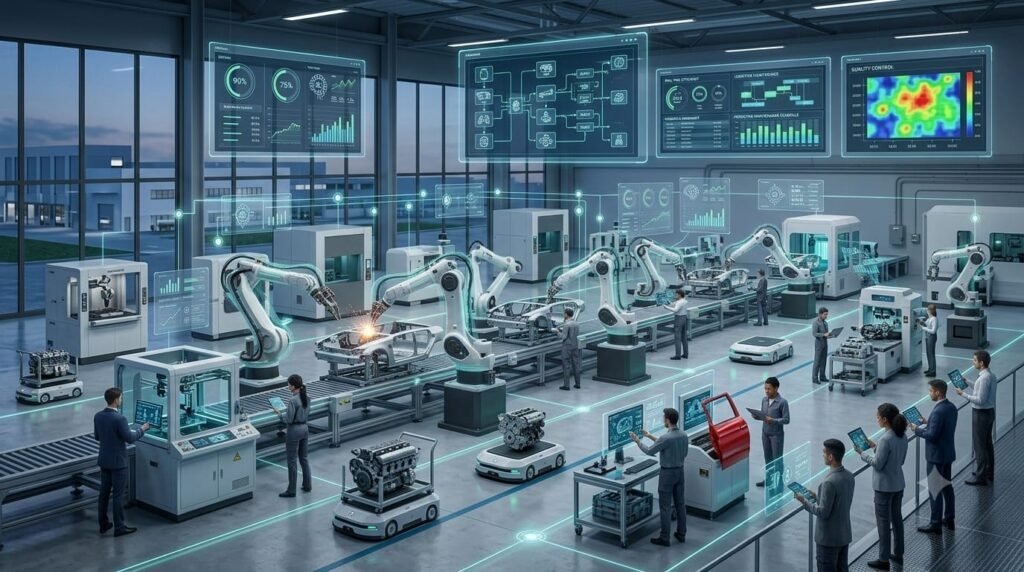
AI can be applied at several stages of the manufacturing process, from the machines on the production floor to the systems that manage inventory and supply chains. Its role depends on the specific problem a manufacturer wants to solve.
Common applications include:
- Predictive maintenance: Identifying signs of equipment problems before failure occurs.
- Quality inspection: Using AI and computer vision to detect defects in products.
- Production optimization: Analyzing production data to improve efficiency and reduce waste.
- Demand forecasting: predicting changes in demand to support better production planning.
- Supply-chain management: Helping businesses manage inventory, suppliers and delivery requirements.
- Robotics and automation: Supporting machines and robots in repetitive or complex manufacturing tasks.
These applications show why AI in manufacturing is broader than factory automation alone. It can influence both physical production and the decisions that support it.
AI for Predictive Maintenance
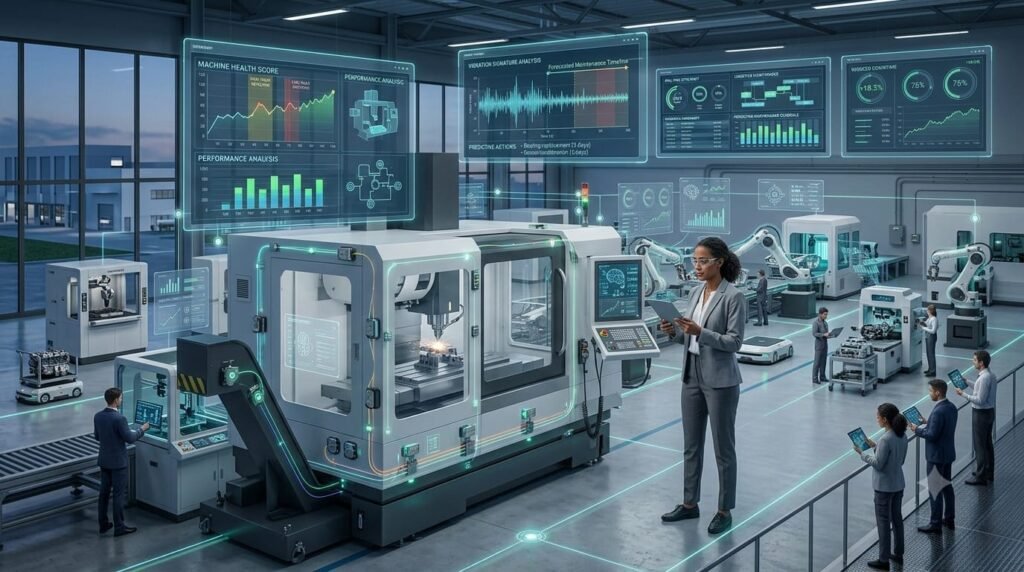
One of the most practical uses of AI in manufacturing is predictive maintenance. Instead of waiting for equipment to break down, AI can analyze data from machines and sensors to identify unusual patterns that may indicate a developing problem.
This allows maintenance teams to act earlier and potentially reduce unexpected downtime. It can also help manufacturers plan maintenance around production schedules instead of stopping operations suddenly. The result is a more proactive approach in which machine data becomes useful for deciding when equipment actually needs attention.
AI in Quality Control and Inspection
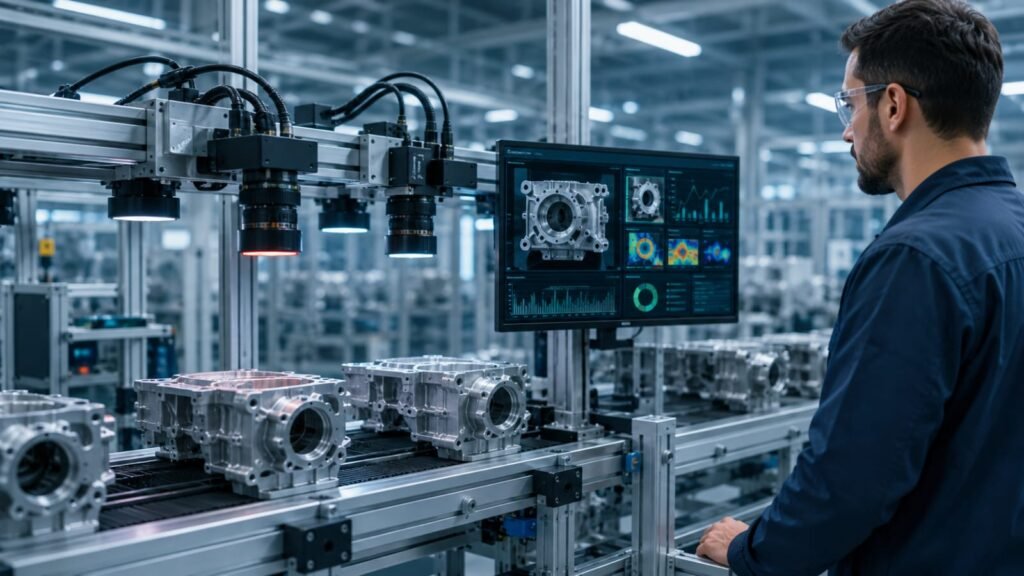
Quality control is another area where AI can make a significant difference. Manufacturing companies can use computer vision and machine learning to examine products, identify defects and detect differences that may be difficult to spot consistently through manual inspection.
For example, cameras placed along a production line can capture images of products while AI analyzes them against defined quality standards. This can make inspections faster and more consistent, while human workers can focus on unusual cases that require closer examination. AI therefore supports quality teams rather than simply removing human involvement.
AI for Production Planning and Optimization
Manufacturing involves many decisions about machines, materials, workers, production schedules and available resources. AI can analyze this information to help manufacturers identify more efficient ways of organizing production.
For example, AI can help predict demand, identify production bottlenecks and suggest adjustments to schedules or resource allocation. This can reduce unnecessary delays and waste while helping factories make better use of their existing capacity. Human managers still play an important role by evaluating these recommendations and making the final operational decisions.
AI in Supply Chain and Inventory Management
Manufacturing depends on a reliable flow of raw materials, components and furnished products. AI can analyze sales data, inventory levels, supplier information and demand patterns to help businesses make better supply-chain decisions.
For example, AI can help predict when certain materials may be needed and identify unusual changes in demand or inventory. This can reduce the risk of having too much stock or running out of important materials. As a result, AI can connect chain rather than treating the factory as a separate system.
AI and Robotics in Manufacturing
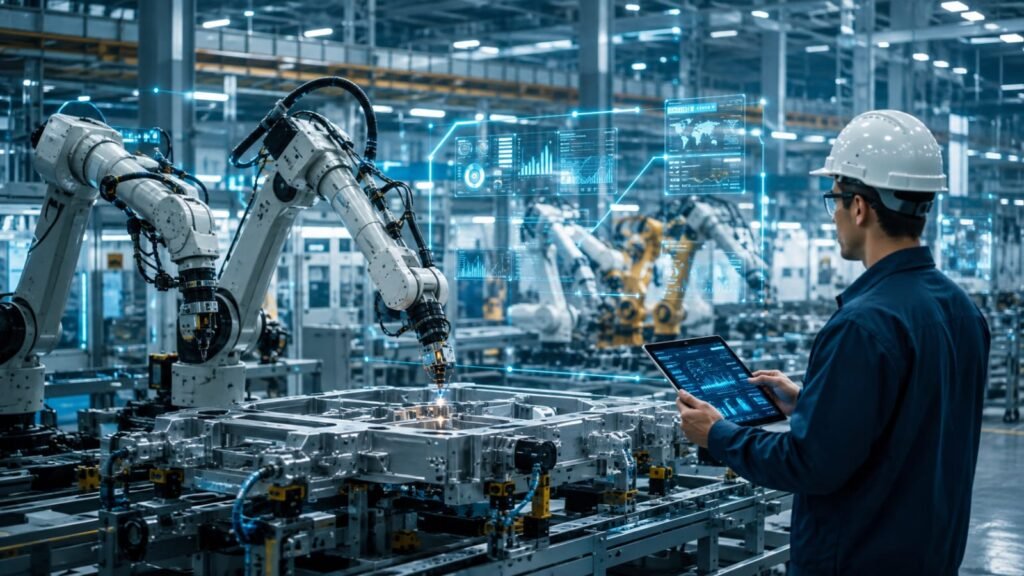
Robotics has been part of manufacturing for years, but AI can make robotic systems more adaptable and capable. Instead of performing only a fixed sequence of movements, AI-supported robots can use sensors, cameras and data to respond to changing conditions.
This can be useful for tasks such as material handling, assembly, inspection and other repetitive processes. Human workers can then focus on supervision, problem-solving and tasks that require greater flexibility. The combination of robotics and AI is therefore helping manufacturers move toward more intelligent forms of automation.
AI Manufacturing Tools and Platforms
AI in manufacturing is supported by a growing range of platforms that help companies work with machine data, automate processes, monitor equipment and improve production decisions. These tools are not all designed for the same purpose; some focus on predictive maintenance, while others support computer vision, industrial automation, analytics, or digital manufacturing.
For manufacturers, the right platform depends on the problem they are trying to solve, the type of equipment they already use and how much data their operations generate. A useful comparison therefore needs to look beyond the platform name and consider its main capabilities, integrations and practical use cases.
Popular AI Tools for Manufacturing
Here are some of the major platforms and technologies manufacturers can consider. The focus is on what each one is useful for, rather than simply listing company names.
| Platform / Tools | Main Focus | Useful For |
| Siemens Industrial AI | Industrial automation and AI | Production optimization, industrial operations, predictive maintenance |
| Microsoft Azure AI | Cloud AI and analytics | Machine data, predictive models, connected manufacturing |
| AWS for Manufacturing | Cloud and industrial solutions | loT data analytics, machine monitoring, supply-chain use cases |
| IBM watsonx | Enterprise AI and data | AI-assisted decision-making, analytics and operational insights |
| NVIDIA Industrial AI | AI infrastructure and simulation | Computer vision, robotics, digital twins, factory simulation |
| Google Cloud Manufacturing | Data and AI services | Manufacturing analytics, quality control and operational optimization |
These platforms overlap in some areas, but they are not interchangeable. A manufacturer looking for computer vision may need a different solution from one primarily trying to predict equipment failures or connect factory data across multiple systems. That is why the use case should come before the tool when evaluating AI technology.
How to Choose the Right AI Manufacturing Tool
Choosing an AI manufacturing platform should begin with the problem a factory wants to solve. A company focused on machine downtime may need predictive maintenance, while another may benefit more from computer vision, production analytics or supply-chain forecasting.
Manufacturers should also consider integration, scalability, data security, cost and ease of deployment. The platform needs to work with existing machines and systems rather than creating another disconnected layer of technology. The right tool is therefore not necessarily the one with the most advanced features, but the one that fits the factory’s actual operations and can deliver measurable value.
Benefits of AI in Manufacturing
AI can provide manufacturers with several practical advantages. By analyzing production data and automation suitable tasks, it can help reduce downtime, improve product quality, and make better use of machines and resources.
Another important benefit is better decision-making. AI can identify patterns in large amounts of operational data that may be difficult to recognize manually. This can help manufacturers respond earlier to equipment problems, changing demand, or production inefficiencies while allowing employees to focus on more complex responsibilities.
Challenges and Risks of AI in Manufacturing
Although AI offers many advantages, its implementation can also present challenges. Manufacturing companies may face high initial costs, integration issues with existing equipment and the need for skilled employees who can manage AI systems effectively. In addition, AI depends on high-quality data, so inaccurate or incomplete information can reduce its effectiveness.
Manufacturers must also consider cybersecurity and data protection, particularly when production systems are connected through industrial networks. For this reason, successful AI adoption requires not only advanced technology but also careful planning, employee training and continuous monitoring.
How to Implement AI in Manufacturing
Successful AI implementation usually begins with a specific manufacturing problem rather than trying to automate the entire factory at once. A company might start by addressing machine downtime, quality inspection or production planning and then measure whether the AI solution produces a meaningful improvement.
Once a suitable use case is identified, the business needs reliable data, compatible technology, trained employees and clear performance goals. Starting with a smaller project can also help teams understand what works before expanding AI across wider operations. This gradual approach can make adoption more practical and reduce unnecessary costs and disruption.
Real-World Applications of AI in Manufacturing
AI is already being applied in manufacturing environments to solve practical production problems. Factories can use computer vision to inspect products, predictive systems to monitor equipment and AI-based analytics to understand production performance.
These applications can work together as part of a larger intelligent manufacturing systems. For example, machine data can help predict maintenance needs while production and quality data can reveal where delays or defects are occurring. This allows manufacturers to move beyond individual AI tools and use connected data to improve the wider production process.
19. The Future of AI in Manufacturing
The future of AI in manufacturing is likely to involve more connected and intelligent production systems. As factories collect more data from machines, sensors, robots and supply chains, AI can help bring this information together to support faster and more informed decisions.
Manufacturing may also move toward greater us of digital twins, intelligent robotics, predictive systems and real-time analytics. However, the future will not depend on automation alone. Skilled workers and managers will remain important for interpreting AI recommendations, handling unexpected situations and making decisions that require human judgment.
FAQs
What is AI in manufacturing?
AI in manufacturing means using artificial intelligence to improve production, maintenance, quality control, planning, automation and other manufacturing operations.
How is AI used in manufacturing?
AI can be used for predictive maintenance, quality inspection, demand forecasting, production optimization, inventory management, robotics and analyzing factory data.
What are the benefits of AI in manufacturing?
AI can help reduce downtime, improve product quality, optimize resources, identify production problems earlier and support better operational decisions.
What are some AI tools used in manufacturing?
Manufacturers can use platform and technologies from companies such as Siemens, Microsoft Azure, AWS, IBM, NVIDIA and Google Cloud, depending on their specific use case.
Will AI replace manufacturing workers?
AI can automate certain repetitive tasks, but manufacturing still require human skills for supervision, problem-solving, maintenance, decision-making and managing unexpected situations.
Is AI expensive to implement in manufacturing?
The cost varies depending on the technology, factory size, existing infrastructure and use case. Starting with a focused project can help businesses evaluate the value before expanding AI across their operations.
Conclusion
AI in manufacturing is changing how factories approach production, maintenance, quality, and planning. By turning machine and operational data into useful insights, AI can help manufacturers identify problems earlier, reduce repetitive work and make more informed decisions.
The strongest results are likely to come from combining AI with human expertise rather than treating automation as a complete replacement for workers. With the right tools, reliable data and careful implementation, AI can become an important part of more efficient, connected and intelligent manufacturing.