Introduction
Marketing has become increasingly dependent on data, content, customer insights and fast decision-making. As businesses manage more digital channels, artificial intelligence is becoming a useful way to simplify repetitive marketing tasks and support teams with research, content, analysis and campaign planning.
AI tools for marketing are software platforms that use artificial intelligence to help marketers perform tasks such as content creation, audience research, search engine optimization, social media management, email marketing and data analysis. Rather than replacing marketers, these tools can reduce routine work and give teams more time to focus on strategy and creative decisions.
This guide explores how AI is being used in modern marketing, the different types of AI marketing tools available, popular platforms and their key features and what businesses should consider before choosing an AI solution.
What Are AI Tools for Marketing?
AI marketing tools are software platforms that use artificial intelligence to help businesses plan, create, analyze and improve their marketing activities. They can assist with tasks that would otherwise require significant amounts of manual research or repetitive work.
For example, an AI tool can help a marketer generate content ideas, analyze customer data, identify search trends, improve written content, or organize campaign information. Different tools are designed for different purposes, so businesses usually choose them based on the specific marketing tasks they want to improve.
How AI Is Used in Marketing
AI can support marketing across several stages of a campaign, from researching an audience to creating content and analyzing results. Its role depends on the type of marketing activity and the specific tool being used.
Common applications include:
- Content creation: Generating drafts, ideas, headlines and other marketing material.
- SEO: Supporting keyword research, content optimization and search analysis.
- Social media: Helping plan posts, create content and organize publishing workflows.
- Email marketing: Assisting with email drafts, audience segmentation and campaign personalization.
- Customer insights: Analyzing data to identify patterns, preferences and trends.
- Marketing analytics: Helping teams understand campaign performance and identify areas for improvement.

These applications make AI useful across both creative and analytical sides of marketing, while human marketers remain responsible for strategy, accuracy and final decisions.
AI Tools for Content Creation
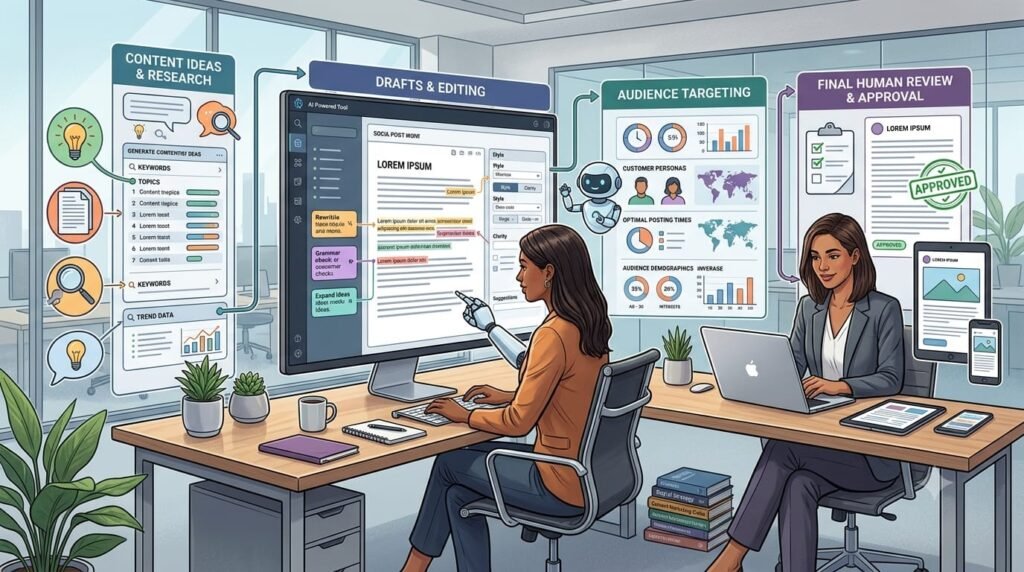
Content creation is one of the most common uses of AI in marketing. AI-powered platforms can help marketers brainstorm topics, create initial drafts, rewrite existing material and develop different versions of content for different audiences or channels.
These tools can be useful when marketing teams need to produce content regularly. However, AI-generated material still needs human review to ensure that it is accurate, original, relevant to the audience and consistent with the brand’s voice. The strongest approach is to use AI as a content support tool, while marketers remain responsible for the final result.
AI Tools for SEO
SEO is another area where AI can help marketers work more efficiently. AI-powered SEO tools can assist with keyword research, content optimization, search intent analysis, competitor research and identifying opportunities to improve existing pages.
For example, marketers can use AI to organize keyword ideas and analyze whether content matches what users are searching for. These tools can speed up the research and optimization process, but they should not replace human judgment. Marketers still need to evaluate search intent, content quality and whether the recommendations actually make sense for their audience.
AI Tools for Social Media Marketing
AI tools can help social media teams manage the repetitive parts of creating and organizing content. They can assist with generating post ideas, writing captions and organizing publishing schedules.
AI can also help marketers review engagement data and identify patterns in audience responses. However, successful social media marketing still depends on understanding the audience, choosing the right message and maintaining an authentic brand voice. AI can speed up the workflow, but human creativity and judgment remain important.
AI Tools for Email Marketing
AI tools can help marketing teams make email campaigns more efficient by supporting tasks such as writing email drafts, generating subject-line ideas, organizing audiences and analyzing campaign performance.
Some platforms can also use customer data to help marketers create more personalized messages for different audience segments. This can make email campaigns more relevant while reducing repetitive work for marketing teams. However, marketers should review AI-generated emails carefully to maintain accuracy, brand consistency, and an appropriate tone.
AI Tools for Marketing Analytics
Marketing teams can use AI tools to analyze campaign data and turn large amounts of information into useful insights. These tools can help identify patterns in customer behavior, compare campaign performance and highlight areas that may need improvement.
For example, AI-powered analytics can help marketers understand which channels are generating engagement, how audiences are responding to campaigns and where marketing resources may be better allocated. However, AI-generated insights should be interpreted in context because numbers alone do not always explain why a campaign performed well or poorly.
Popular AI Tools for Marketing
The AI marketing tool landscape includes platforms designed for different parts of the marketing process. Some focus on content creation and SEO, while others support customer relationship management, email campaigns, analytics or social media workflows.
| AI Marketing Tool | Main Focus | Best For |
| Jasper | AI content creation | Marketing content and brand messaging |
| HubSpot | Marketing, CRM and AI automation | Businesses managing multiple marketing workflows |
| Semrush | SEO and marketing intelligence | Keyword research, SEO and competitive analysis |
| Canva | AI-assisted design and content | Social media graphics and visual marketing |
| Mailchimp | Email marketing and automation | Email campaigns and audience management |
| Sprout Social | Social media management and analytics | Social publishing, engagement and reporting |

These tools are not direct substitutes for one another. The best choice depends on the marketing activity a business wants to improve, its existing software, budget and the level of automation it needs.
How to Choose the Right AI Marketing Tool
Choosing an AI marketing tool should start with the specific task a business wants to improve. A company focused on SEO may benefit from a specialized SEO platform, while a business managing email campaigns may need a tool designed around customer communication and automation. An AI platform for business can also help teams connect marketing activities with broader business workflows.
Before choosing a platform, marketers should consider features, integrations, pricing, ease of use, data privacy, scalability and the amount of human control available. It is also important to check whether the tool fits into the company’s existing workflow rather than adding unnecessary complexity.
The right AI marketing tool is not simply the one with the most features. It is the one that solves a genuine marketing problem and helps the team work more effectively.
Benefits of AI Tools for Marketing
AI marketing tools can help businesses save time, streamline repetitive tasks and support faster decision-making. By assisting with content, SEO, social media, email campaigns, and analytics, they can reduce the amount of manual work required from marketing teams.
Another benefit is scalability. Businesses can use AI to manage larger amounts of content and customer data without increasing every task at the same rate. However, the best results usually come when AI tools support experienced marketers rather than replacing human creativity, strategy and judgment.
Challenges and Limitations of AI Marketing Tools
AI marketing tools can make many tasks faster, but they also have limitations. AI-generated content may contain inaccurate information, repetitive ideas, or messaging that does not fully match a brand’s tone. Over-reliance on automation can also make marketing feel less original or personal.
Businesses should also consider data privacy, security, cost and tool dependency when adopting AI platforms. Human review remains important for checking accuracy, protecting brands identity and making strategic decisions. AI works best as a support system rather than a complete replacement for marketing expertise.

How to Use AI Marketing Tools Effectively
Businesses should begin by identifying a specific marketing problem before choosing an AI tool. For example, a team might start with keyword research, content creation, email automation or campaign analysis rather than trying to automate every marketing activity at once.
After selecting a suitable tool, marketers should establish clear goals and review the results regularly. AI-generated content and recommendations should be checked before publication, while performance data can be used to improve future campaigns. AI workflow automation tools can also help businesses streamline repetitive marketing tasks and workflows.
A gradual approach allows businesses to understand where AI provides genuine value while keeping human creativity, strategy and oversight at the center of the marketing process.
The Future of AI in Marketing
AI is likely to become more deeply integrated into marketing as businesses collect more customer data and use more digital channels. Future AI tools may help marketers understand audiences, personalize campaigns, analyze results and manage larger parts of marketing workflows from a single platform.
However, the future of AI marketing will not be about automation alone. Human creativity, brand strategy, ethical judgment and customer understanding will remain important. Businesses that combine AI efficiency with human expertise can use these technologies more effectively while maintaining the quality and authenticity of their marketing.
FAQs
What are AI tools for marketing?
AI marketing tools are software platforms that use artificial intelligence to help businesses with tasks such as content creation, SEO, social media, email marketing, customer insights and campaign analysis.
How can AI help with marketing?
AI can help marketers research audiences, generate content ideas, optimize campaigns, analyze data and automate repetitive marketing tasks.
What are some popular AI marketing tools?
Popular platforms include Jasper, Hubspot, Semrush, Canva, Mailchimp and Sprout Social Each platform has different features and focuses on different marketing needs.
Can AI replace marketing professionals?
AI can automate certain repetitive tasks, but it does not completely replace marketing professionals. Human creativity, strategy, brand knowledge and decision-making remain important.
Are AI marketing tools worth using?
They can be valuable when they solve a specific business problem and are integrated properly into the marketing workflow. Businesses should evaluate the tool’s features, cost, security and actual results before adopting it.
What should businesses consider before choosing an AI marketing tool?
Businesses should consider their goals, budget, existing software, integrations, data privacy, scalability, ease of use and the amount of human oversight required.
Conclusion
AI tools are becoming an important part of modern marketing by helping businesses create content, improve SEO, manage social media, personalize email campaigns and analyze marketing performance.
However, using AI effectively is not simply about automating as many tasks as possible. Businesses need to choose tools that fit their goals, review AI-generated work, protect customer data and maintain human creativity and strategic judgment. When used thoughtfully, AI marketing tools can help teams work faster, make better use of data and focus more attention on meaningful marketing decisions.