Introduction
Technology is changing the way people work, learn and manage everyday tasks. One of the most useful developments in this area is the artificial intelligence assistant, Which can understand human instructions and help with a wide range of activities.
Unlike traditional software that usually follows fixed commands, an AI assistant can understand natural language, process information and respond according to the situation. It can help a person write, research, organize information, solve problems or complete routine tasks.
This guide explains what an AI assistant is, how it works, what it can do, where it is useful and what people should consider before depending on one. The aim is to understand both its possibilities and its limitations.
What is an Artificial Intelligence Assistant?
An artificial intelligence assistant is a software system designed to understand human instructions and provide useful responses or support. It can work with text, voice or other forms of input and can help users complete tasks without requiring them to learn complicated commands.
What makes these assistants different is their ability to understand context. Instead of simply following a fixed set of instructions, they can process a request, identify what the user needs, and respond accordingly. This makes them useful for both simple daily tasks and more complex work.
How Does an AI Assistant Work?
An AI assistant works by taking a uses’s request, understanding its meaning and producing a useful response or action. It uses technologies such as natural language processing and machine learning to understand works, context and patterns in information.
For example, when a user asks an AI assistant to summarize a document, the system first processes the information, identifies the important points and then creates a shorter version. More advanced assistants can also connect with other software or tools to complete tasks instead of only providing an answer.

The quality of the result depends on the AI system, the information available to it and how clearly the user explains the task.
What Can an AI Assistant Do?
An AI assistant can support users across many different tasks. Its usefulness depends on the system and the tools it can access, but common abilities include:
- Answering questions: It can explain topics and provide information in simple language.
- Writing and editing: It can help create drafts, summaries, emails and other content.
- Research support: It can organize information and help users understand complex subjects.
- Task organization: It can help plan projects, create lists and structure daily work.
- Problem-solving: It can analyze information and suggest possible solutions.

These abilities make AI assistants useful because one system can support several types of work instead of being limited to a single task.
Artificial Intelligence Assistants in Everyday Life
AI assistants are becoming part of many everyday activities, often without users thinking of them as advanced technology. People can use them to find information, draft messages, summarize long content, organize ideas or explain difficult topics in simpler way.
They can also make routine tasks easier by helping users plan their work, prepare lists or manage information. The main advantage is convenience: instead of searching through many sources or completing every small task manually, users can ask for assistance in natural language and receive help in a short time.
AI Assistants in Business
Businesses can use AI assistants to support employees and improve everyday operations. They can help with tasks such as drafting emails, summarizing meetings, preparing reports, researching information and organizing large amounts of content.
AI assistants can also reduce repetitive work, giving employees more time for tasks that require creativity, communication and decision-making. However, businesses still need human review, especially when the assistant works with important information or supports decisions that could affect customers or the company.

AI Assistant vs. Chatbot
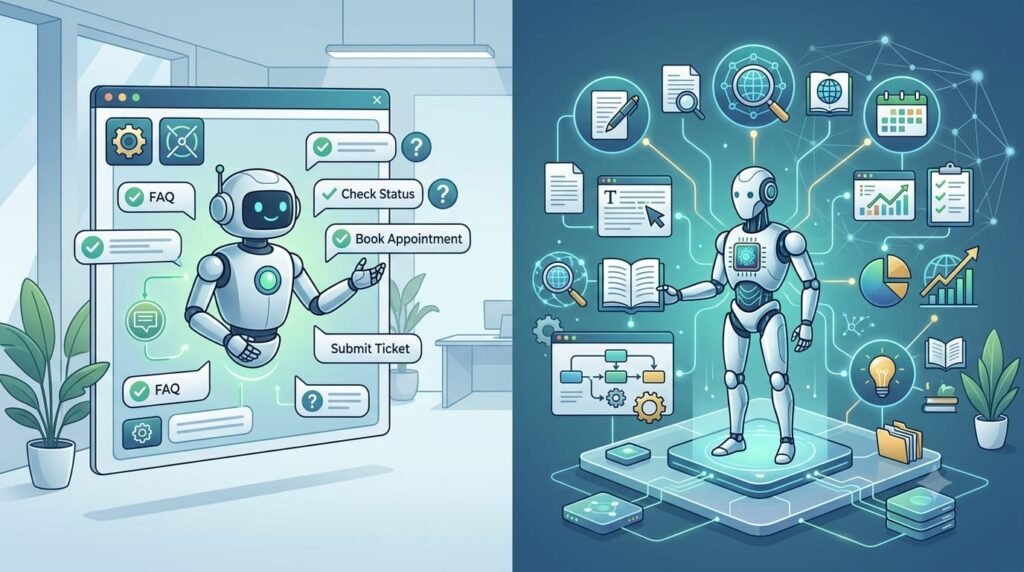
AI assistants and chatbot may seem similar, but they are not exactly the same. A chatbot is usually designed to communicate with users and answer questions within a specific service or topic. An AI assistant can have a wider role and may help with writing, research, planning, analysis and other tasks.
The main difference is flexibility. A chatbot often responds within a defined set of customer or business needs, while an AI assistant can understand broader instructions and systems can even combine chatbot-style communication with more advanced assistant features.
Benefits of an Artificial Intelligence Assistant
An artificial intelligence assistant can make work easier by reducing the time spent on repetitive or information-heavy tasks. Instead of starting every task from zero, users can ask the assistant to create a first draft, summarize information, organize ideas, or explain a difficult topic.
Another benefit is accessibility. AI assistants can provide support through natural language, which means users do not need to understand complex software commands. For businesses, this can improve employees productivity, while individuals can use the same technology for learning, planning and everyday tasks.
Limitations and Risks of AI Assistants
AI assistants can be useful, but they are not always correct. They may misunderstanding a request, produce inaccurate information, or give an answer that sounds convincing even when the details are wrong. This is why important information should be checked before it is used.
Privacy is another concern. AI assistants may work with personal, business, or other sensitive information, so users should understand how their data is handle. There is also a risk of depending on AI too much, especially when a task requires human judgment, experience or creativity.
How to Choose the Right Artificial Intelligence Assistant?
Choosing an AI assistant should start with the user’s actual needs rather than the number of features a platform offers. Someone who mainly needs help with writing may need a different assistant from a business that wants research, data analysis and task automation.
It is also important to consider accuracy, privacy, ease of use, integrations and cost. An assistant should fit naturally into the user’s existing workflow and provide reliable results. For important tasks, users should also have a clear way to review and correct AI-generated information.
Example of Popular AI Assistants
Different AI assistants are designed for different types of users and tasks. Some focus on general conversations and writing, while others are closely connected to workplace software, search or productivity tools.
For example, ChatGPT can support writing, learning, brainstorming and problem-solving. Google Gemini can assist with research, writing and information-based tasks, while Microsoft Copilot is designed to work closely with Microsoft’s productivity environment. These examples show that choosing an AI assistant is often less about finding one “best” option and more about finding the system that matches a user’s needs.
The Future of AI Assistants
AI assistants are likely to become more useful as they improve at understanding context and handling multiple tasks. Instead of only answering questions, future assistants may be able to help users manage complete workflows, connect different applications, and provide more personalized support.
However, greater capability will also require greater responsibility. Accuracy, privacy, and human oversight will remain important as people give AI assistants access to more information and tasks. The future will likely focus not on replacing people, but on creating better ways for humans and AI to work together.
FAQs
What is an artificial intelligence assistant?
An artificial intelligence assistant is software that uses AI to understand user instructions and help with tasks such as answering questions, writing, research, planning and organizing information.
What is the difference between an AI assistant and a chatbot?
A chatbot mainly focuses on conversations and pacific questions, while an AI assistant can support a wider range of tasks and workflows.
Can Artificial Intelligence Assistants be used in business?
Yes. businesses can use AI assistants for writing, research, meeting summaries, data organization, customer support and other routine tasks.
Are AI assistants always accurate?
No. AI assistants can sometimes produce incorrect or incomplete information. Important results should be reviewed before they are used.
Are Artificial Intelligence Assistants safe to use?
They can be useful when used responsibly, but users should understand how their information is handled and avoid sharing sensitive data without checking privacy and security practices.
Conclusion
An artificial intelligence assistant can make many types of work easier by helping users understand information, create content, organize tasks and complete routine activities. Its biggest value comes from saving time while giving people a simple way to interact with advanced technology.
At the same time, AI should be treated as an assistant rather than an unquestionable source of information. Human judgment, privacy and careful review still matter. When used thoughtfully, AI assistants can become a practical part of both everyday life and professional work.
Pingback: AI Productivity: A Complete Guide to Working Smarter in 2026