Introduction
AI and Customer Service: A Complete Guide
Customer service has always been about one simple goal: helping people when they need it. But as businesses grow, customer questions grow with them. People expect quick replies, clear answers and support at almost any time of the day. For many businesses, meeting these expectations with human teams alone can become difficult.
This a where AI and customer service come together. Artificial intelligence can help businesses answer common questions, understand customer needs, organize support requests, and assist human agents with routine work. More importantly, AI is changing how customer service teams spend their time. Instead of handing every small request manually, employees can focus more on problems that need human understanding and judgment.
This guide explains how AI is changing customer service, where it provides the most value, what businesses should be careful about and how companies can use it without losing the human side of customer support.
What Does AI Mean in Customer Service?
Customer support automation guide means using artificial intelligence to help businesses communicate with customers and manage support tasks. It can understand questions, suggest answers, find information and handle simple requests quickly.
AI can also help behind the scenes by organizing support requests, summarizing customer conversations, and giving human agents useful information. This allows employees to spend more time on difficult issues that need human judgment and understanding.
The goal is not to replace human support. Instead, AI can handle suitable routine tasks while human agents focus on the parts of customer survive where empathy and personal communication are important.
How AI Has Changed Customer Service?
Customer service used to depend heavily on human agents answering questions one by one. AI has changed this process by making support faster and more organized. Businesses can now respond to common questions, sort customer requests and provide help at different times of the day.
Another important change is the support given to human agents. AI can summarize long conversations, find relevant information and suggest possible responses. This means agents can spend less time searching for information and more time understanding the customer’s actual problem.
The biggest change, however, is the balance between speed and human support. AI can handle simple and repetitive work, while people can focus on situations that require patience, judgment and empathy.
Where AI Adds the Most Value in Customer Service
AI becomes most useful when customer service teams deal with a large number of similar requests. Instead of making an agent answer the same basic questions repeatedly, AI can provide quick responses and guide customers toward the right information.
It can also support agents during more complex conversations by finding relevant details, summarizing previous messages and suggesting useful next steps. This combination allows businesses to improve response speed without making every customer interaction feel completely automated.
How AI Is Used in Customer Service
AI can support customer service in several practical ways. It can answer common question, help customers find information, and send simple requests to the right department.
It can also help support teams by summarizing conversations, organizing customer requests, suggesting replies and identifying repeated problems. These uses can reduce routine work and give employees more time to deal with complex customer needs.
The value of AI depends on using it for the right tasks. Simple and repetitive requests are often a good starting point, while sensitive or complicated issues may still need a human agent.
AI Chatbots and Virtual Assistants

One of the most visible uses of AI in customer service is the chatbot. It can answer common questions, guide customers through simple steps and provide basic support without making them wait for an agent.
Virtual assistants can also work beyond simple questions. They may understand the context of a conversation and help customers find the right information or service. When a request needs human judgment, the conversation can be transferred to an agent.
AI for Customer Service Agents

AI does not only work directly with customers. It can also act as a support system for customer service agents. During a conversation, AI can quickly find relevant information, summarize previous messages and suggest possible responses.
This can reduce the time agents spend searching through documents or reviewing long conversations. As a result, agents can focus more on understanding the customer and solving the problem instead of spending most of their time on routine tasks.
AI for personalized Customer Support
Good customer service is not only about answering quickly; it is also about understanding what a customer actually needs. AI can help businesses move toward more personalized support by using information from previous conversations, customer preferences, purchase history and other relevant data
For example, if a returning customer contacts a company about a previous order, an AI system may help the support team understand the customer’s history before the conversation even begins. It can also suggest information or responses that are more of giving the same general answer to everyone.
This can make customer interactions feel more useful and connected. However, personalization should be handled carefully. Businesses need to protect customer information and make sure AI uses data responsibly. The goal should be to make support more helpful, not to make customers feel that every part of their activity is being watched or analyzed.
The Role of Data in AI Customer Service
Data plays an important role in making AI more useful. Information from customer conversation, feedback, purchase history and support requests can help AI understand common questions and recognize patterns in customer needs.
For example, if many customers report the same problem, AI can help the business identify that issue and give the support team a clearer picture of what customers are experiencing. At the same time, businesses must protect customer information and use it responsibly. AI can improve support, but customer privacy should always remain an important part of the process.
Artificial intelligence vs. Human Customer Service
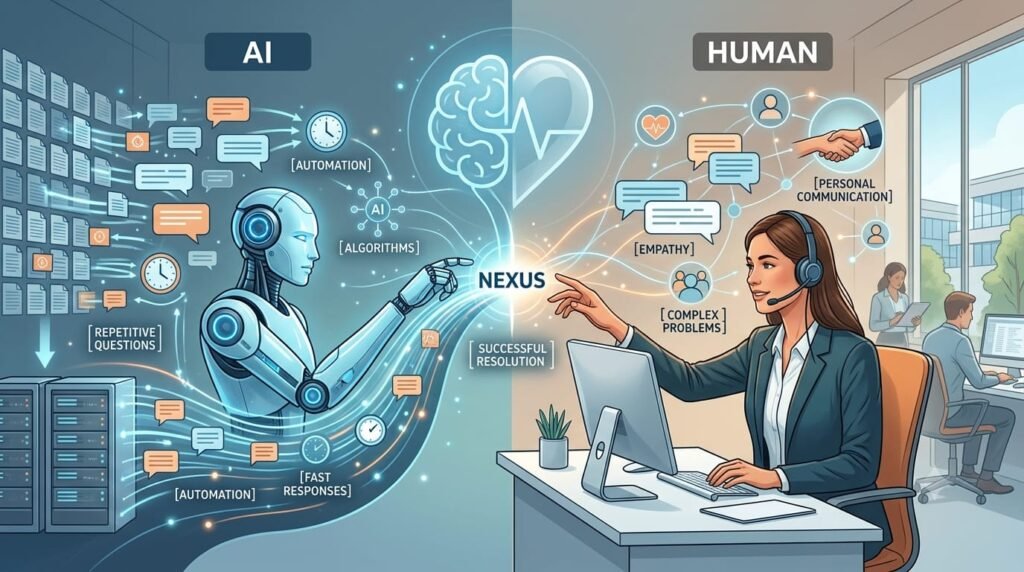
Artificial intelligence can handle many customer service tasks quickly, but it cannot fully replace human support. AI is useful for repetitive questions, basic troubleshooting and providing information, while human agents are better prepared for situations that require empathy, careful judgment, or a deeper understanding of the customer’s problem. AI and customer service can work together to handle repetitive questions while human agents focus on complex customer needs.
The strongest customer service approach often combines both. AI can mange simple requests and assist agents with information, while employees take control when a situation becomes sensitive or complicated. This balance can help businesses provide faster support without losing the human connection that customers still value.
Where AI Work Best and where Humans Are Still Needed
AI works best when a customer service task is repetitive, predictable and based on clear information. Questions about orders, account details, basic troubleshooting and common policies can often be handled quickly by AI.
Human support becomes more important when a customer has a sensitive complaint, a complicated problem, or a situation that needs empathy and careful judgment. In these cases, a human can understand emotions and context in ways an automated system may not.
The best approach is therefore not to choose AI over people. It is to give each one the type of work they can handle best.
Challenges and Risks of AI in Customer Service
AI can improve customer service, but it also brings challenges that businesses should consider before relying on it too heavily. An AI system may sometimes misunderstand a customer’s question or provide an answer that sounds correct but is not accurate. If there is no easy way to reach a human agent, this can make the customer experience even more frustrating.
Privacy is another important concern. Customer service systems often work with personal information, so businesses need to protect customer data and use it responsibly. Ai can also reduce the personal feeling if support when every interaction becomes automated. For this reason, businesses need clear rules about when AI should help and when a human should take over.
How Businesses Can Implement AI Successfully
Successful AI implementation starts with identifying the customer service problems that need the most attention. A business does not need to automate everything at once. It can begin with simple tasks, such as answering common questions or organizing support requests, and then expand AI use as the team gains experience.
Businesses should also prepare their employees for the change. Customer service agents need to understand how AI works, how to check its responses, and when they should take control of a conversation Regularly reviewing AI performance is equally important because customer needs change over time.
The goal should be to build a support system where AI improves speed and efficiency while human employees remain responsible for important decisions and customer relationships.
Real-World Examples of AI in Customer Service
Many businesses are already using AI to make customer support faster and more organized. E-commerce companies, for example, can use AI to answer questions about orders, returns, and delivery updates. This allows customers to get basic information without waiting for an employees.
Other businesses AI to help support agents rather than communicate directly with customers. AI can summarize previous conversations, find relevant information, and suggest responses. These examples show that the value of AI is not limited to chatbots. It can support the entire customer service process while allowing human teams to focus on more complex customer needs.
How to choose the Right AI Customer Service Solution
Choosing an AI solution should begin with the business’s actual customer service needs. A company should consider what type of questions it receives most often, how large its support team is, and which tasks take the most time. This helps businesses choose technology that solves real problems instead of adding unnecessary complexity.
Cost, security, integration, accuracy and ease of use should also be considered. The solution should work with the tools the business already uses and provide a clear way for customers to reach human agents when needed. A good AI customer service solution is not simply the one with the most features; it is the one that fits the business and improves the customer experience.
The Future of AI and Customer Service
The role of AI in customer service is likely to grow as businesses become better at using customer data and automation. Future systems may become better at understanding the context of conversations, predicting customer needs and helping agents solve problems before they become larger issues.
However, the future of customer service is unlikely to be completely automated. Customers will still need human support when situations are sensitive, unusual or emotionally difficult. The most effective approach will likely be a combination of AI’s speed and human judgment, creating support that is both efficient and personal.
FAQs
What is AI customer service?
AI and customer service refers to using artificial intelligence to help businesses support customers through automated answers, information retrieval, request management and agent assistance.
How does AI improve customer service?
AI can provide faster responses, handle repetitive questions, organize support requests and help human agents find information quickly.
Can AI replace customer service agents?
AI can handle many routine tasks, but it cannot fully replace human agents. Complex problems, sensitive complaints and situations requiring empathy still benefit from human support.
Is AI customer service suitable for small businesses?
Yes. small businesses can start with simple AI features such as answering common questions or organizing customer requests and expand their use as their needs grow.
What should businesses consider before using AI for customer service?
Businesses should consider accuracy, privacy, security, cost, integration, ease of use and the ability to transfer customers to human agents when necessary.
Conclusion
AI is changing customer service by making routine support faster, helping agents work more efficiently and giving businesses new ways to understand customer needs. But its value does not come from automation alone. The best results come when businesses know which tasks AI should handle and where human support is still necessary.
AI and customer service should therefore be viewed as a partnership rather than a replacement. When businesses combine AI’s speed with human judgment, they can create support that is more efficient while still giving customers the understanding and personal attention they expect.
Pingback: AI Productivity: A Complete Guide to Working Smarter in 2026